Islands in the Indian Ocean: SDUK, c.1840
-
Title: Islands in the Indian Ocean
- Author: Society for the Diffusion of Useful Knowledge [SDUK]
- Date: c.1840
- Condition: Excellent
- Inches: 15 1/2 x 12 1/8 [Image]
- Centimeters: 39.37 x 30.79 [Image]
- Product ID: 308695
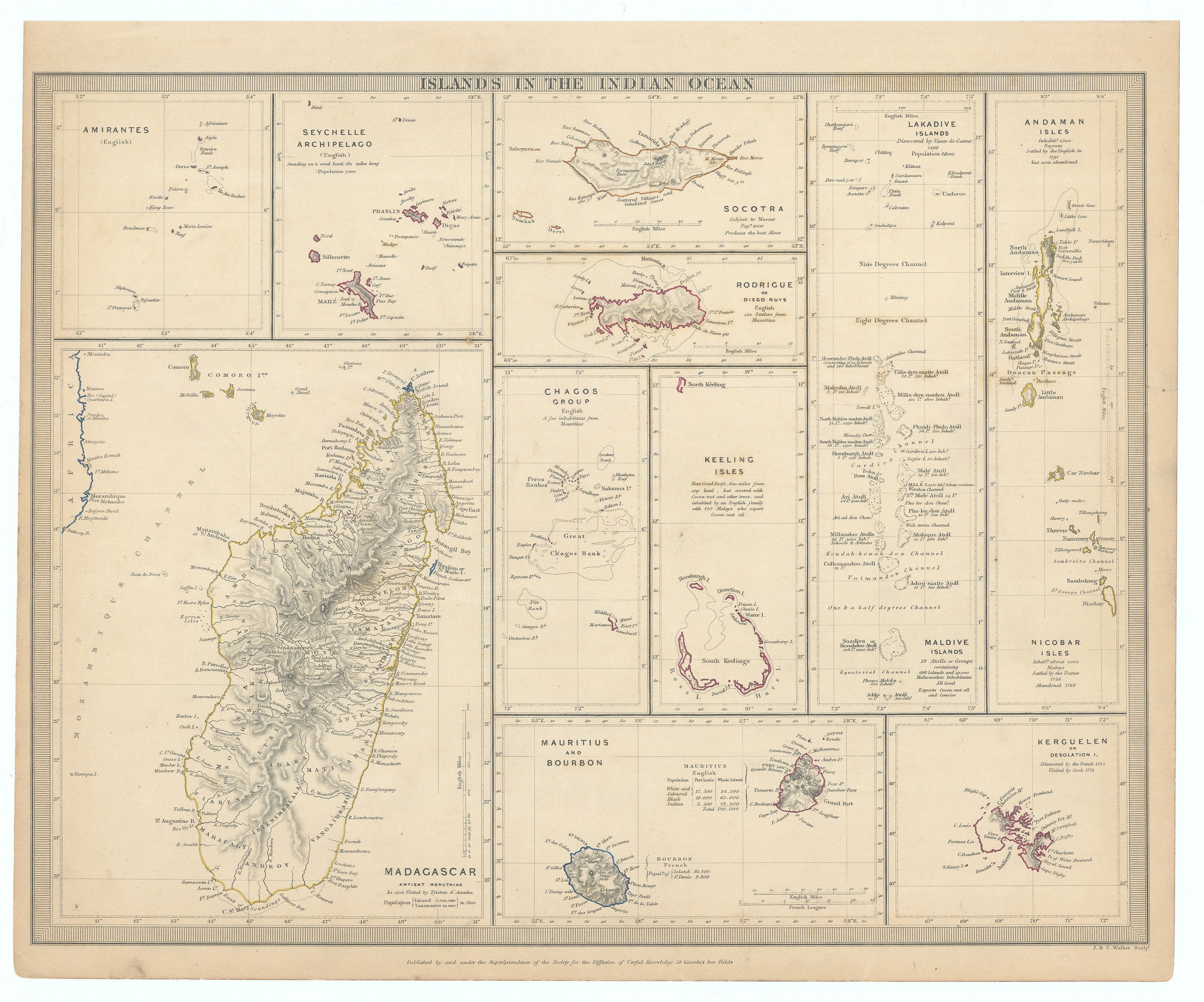
This Society for the Diffusion of Useful Knowledge map, presents a finely engraved suite of panels that systematically charts Madagascar and the principal island groups of the western and central Indian Ocean—including the Seychelles, Amirantes, Socotra, Chagos, Keeling, Maldives, Nicobars, Andamans, Mauritius, Bourbon (Réunion), and Kerguelen—with careful coastal delineation, hachured relief, soundings, and densely lettered place-names that reflect the society’s characteristic union of scientific precision and clear, didactic design.
Background on Creator
The Society for the Diffusion of Useful Knowledge (SDUK) was a London-based educational reform society founded in 1826 under the leadership of Henry Brougham. Its aim was to make inexpensive, reliable works on science, geography, history, and other “useful” subjects available to readers who lacked formal schooling or preferred self-education, using cheap series such as the Library of Useful Knowledge and the Penny Magazine. Operating through the mid‑nineteenth century, it helped pioneer mass-market, secular educational publishing and became emblematic of the Victorian “march of intellect” ideal that knowledge should be widely and affordably shared.
-
Title: Islands in the Indian Ocean
- Author: Society for the Diffusion of Useful Knowledge [SDUK]
- Date: c.1840
- Condition: Excellent
- Inches: 15 1/2 x 12 1/8 [Image]
- Centimeters: 39.37 x 30.79 [Image]
- Product ID: 308695
This Society for the Diffusion of Useful Knowledge map, presents a finely engraved suite of panels that systematically charts Madagascar and the principal island groups of the western and central Indian Ocean—including the Seychelles, Amirantes, Socotra, Chagos, Keeling, Maldives, Nicobars, Andamans, Mauritius, Bourbon (Réunion), and Kerguelen—with careful coastal delineation, hachured relief, soundings, and densely lettered place-names that reflect the society’s characteristic union of scientific precision and clear, didactic design.
Background on Creator
The Society for the Diffusion of Useful Knowledge (SDUK) was a London-based educational reform society founded in 1826 under the leadership of Henry Brougham. Its aim was to make inexpensive, reliable works on science, geography, history, and other “useful” subjects available to readers who lacked formal schooling or preferred self-education, using cheap series such as the Library of Useful Knowledge and the Penny Magazine. Operating through the mid‑nineteenth century, it helped pioneer mass-market, secular educational publishing and became emblematic of the Victorian “march of intellect” ideal that knowledge should be widely and affordably shared.
Description
-
Title: Islands in the Indian Ocean
- Author: Society for the Diffusion of Useful Knowledge [SDUK]
- Date: c.1840
- Condition: Excellent
- Inches: 15 1/2 x 12 1/8 [Image]
- Centimeters: 39.37 x 30.79 [Image]
- Product ID: 308695
This Society for the Diffusion of Useful Knowledge map, presents a finely engraved suite of panels that systematically charts Madagascar and the principal island groups of the western and central Indian Ocean—including the Seychelles, Amirantes, Socotra, Chagos, Keeling, Maldives, Nicobars, Andamans, Mauritius, Bourbon (Réunion), and Kerguelen—with careful coastal delineation, hachured relief, soundings, and densely lettered place-names that reflect the society’s characteristic union of scientific precision and clear, didactic design.
Background on Creator
The Society for the Diffusion of Useful Knowledge (SDUK) was a London-based educational reform society founded in 1826 under the leadership of Henry Brougham. Its aim was to make inexpensive, reliable works on science, geography, history, and other “useful” subjects available to readers who lacked formal schooling or preferred self-education, using cheap series such as the Library of Useful Knowledge and the Penny Magazine. Operating through the mid‑nineteenth century, it helped pioneer mass-market, secular educational publishing and became emblematic of the Victorian “march of intellect” ideal that knowledge should be widely and affordably shared.