Pearl Harbor and The Pacific Fleet: United States Navy Yard, Pearl Harbor, c.1943
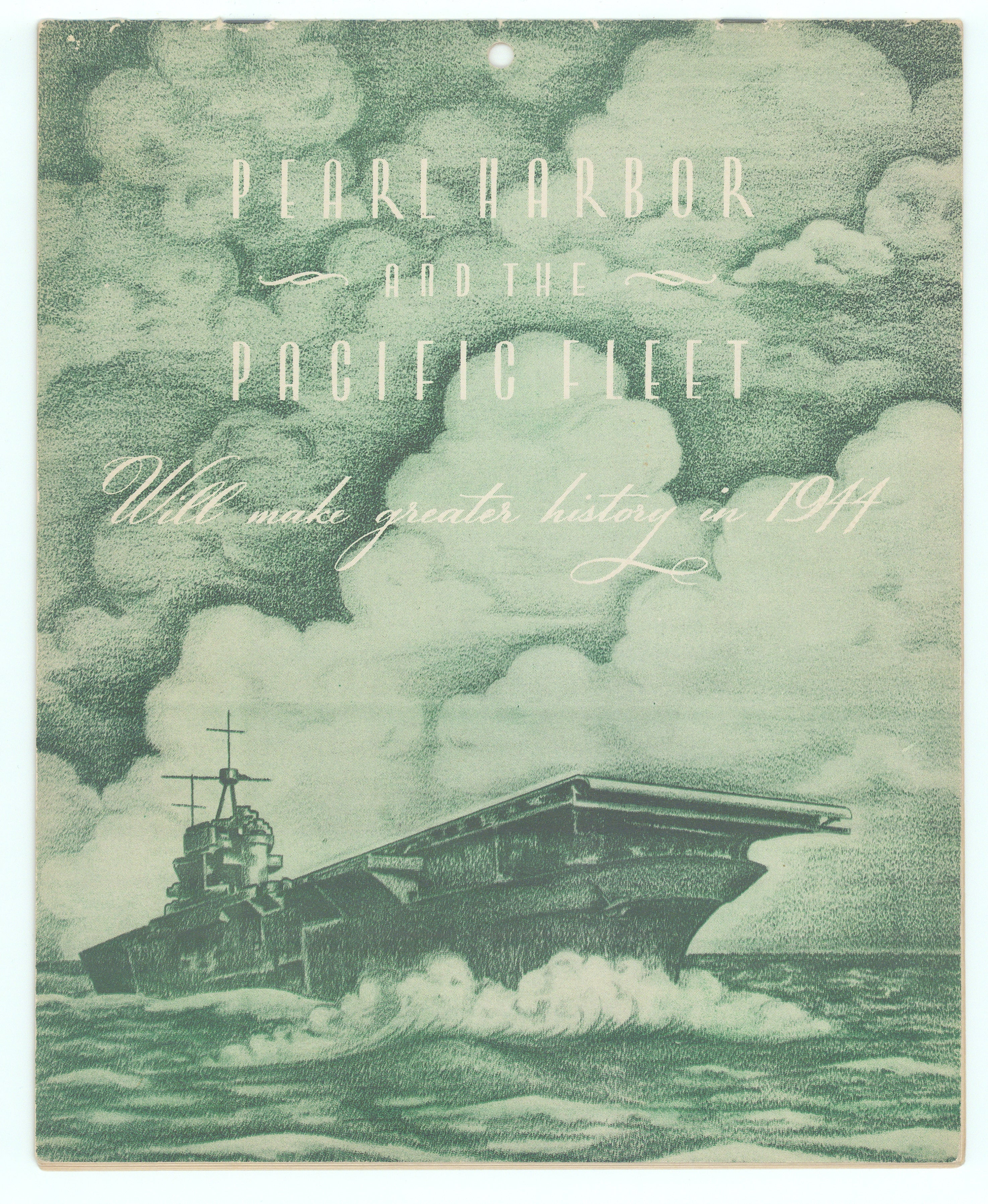
- Title: PEARL HARBOR AND THE PACIFIC FLEET | Will make greater history in 1944
-
Author: United States Navy Yard, Pearl Harbor
- Date: c.1943
- Condition: See description
- Inches: 8 1/4 x 10 1/8 [Calendar]
- Centimeters: 20.95 x 25.71 [Calendar]
- Product ID: 308487
The Only Known Surviving Calendar for 1944 Created by the Pearl Harbor Navy Yard
This is an original 1944 calendar printed by the Pearl Harbor Navy Yard, a rare artifact from one of the most significant naval facilities of World War II. Produced during a pivotal year in the Pacific campaign, the calendar reflects the daily life and operational tempo of the yard as it supported the U.S. Navy’s war effort. Its pages feature period-specific artwork, naval insignia, comic, and inspirational messages intended to boost morale among shipyard workers and sailors. As few such items were preserved, it stands as a tangible link to the wartime activities and culture at Pearl Harbor. The calendar’s historical value is heightened by its association with the Navy Yard’s legendary repair and salvage operations, including the restoration of battleships and support of fleet logistics. This artifact offers a unique window into the home front contributions that were essential to Allied victory in the Pacific.
Printing at the Navy Yard
The Pearl Harbor Navy Yard in 1944 produced a variety of printed materials, including at least one calendar. According to the Naval History and Heritage Command's manuscript index, there is a reference to a "Pearl Harbor calendar from 1944" among other documents such as operational schedules, shipyard bulletins, technical manuals, personnel rosters, newsletters, posters, and notices.
There is no evidence of such a calendar being available or existing in any public or private collection. An exhaustive search of detailed historical records, Navy Yard reports, dealer catalogues, and public sales. None mention the existence, or current whereabouts of a printed calendar from the Pearl Harbor Navy Yard for that year.
The Pearl Harbor Navy Yard
The Pearl Harbor Navy Yard played a vital role as a major repair, salvage, and shipbuilding facility for the United States Pacific Fleet throughout WWII. Following the devastating attack on Pearl Harbor in December 1941, the yard undertook extensive salvage operations to refloat and repair numerous damaged battleships and vessels, such as the Nevada, California, and West Virginia. By 1944, these efforts had restored many ships to active service, significantly contributing to the Navy’s combat strength in the Pacific theater. The yard also specialized in constructing and overhauling harbor craft, including landing boats and motor whaleboats, as well as repairing heavy naval armaments, which were essential for ongoing naval operations and amphibious assaults.
Beyond ship repair and construction, the Pearl Harbor Navy Yard was a critical hub for fleet logistics and operational support. It prepared and maintained vessels for key campaigns, such as the Marianas invasion, ensuring that landing ships and other craft were ready for deployment. The yard also coordinated waterfront work and managed specialized personnel, including divers and salvage teams, who handled underwater recovery and hazardous material removal. Additionally, the Navy Yard played a central role in responding to emergencies like the West Loch disaster in May 1944, which involved explosions among munitions-laden landing ships. Overall, the Pearl Harbor Navy Yard was indispensable in maintaining the readiness and effectiveness of the Pacific Fleet throughout World War II.
The Yorktown Miracle
In one of the most spectacular efforts by the Yard, The USS Yorktown (CV-5), heavily damaged during the Battle of the Coral Sea, arrived at Pearl Harbor on May 27, 1942. Initial estimates suggested she would require at least two weeks—some sources said up to three months—of repairs at a mainland yard like Puget Sound. However, with the urgent need for every available carrier for the upcoming Midway operation, Admiral Nimitz ordered the Pearl Harbor yard to make her battle-ready as quickly as possible.
In an extraordinary effort, 1,400 workers at Pearl Harbor labored around the clock and completed the critical repairs in just 72 hours. They patched the flight deck, replaced major sections of the hull, restored bulkheads and deck plates, and repaired or replaced damaged instruments and wiring. Some repairs were so urgent that work continued at sea as Yorktown sailed to join the fleet, with repair crews from the shipyard and the repair ship USS Vestal working until the last possible moment.
This rapid repair allowed Yorktown to participate in the Battle of Midway, where she played a pivotal role in the American victory. The achievement is widely recognized as one of the most remarkable episodes in naval repair history and was crucial to the outcome of the battle.
Rarity
The only known copy. No institutional holdings, no sales records.
Condition
Two tone print on creamy, textured paper. Four stapled, folded sheets, with small, hole centered at the top margin cleanly punched for hanging. Other than very mild age toning, the calendar is flawless
References
Department of Defense. (2020). The "MAGIC" Background of Pearl Harbor (Vol. I). U.S. Government Printing Office. Retrieved from https://www.history.navy.mil/research/library/online-reading-room/title-list-alphabetically/m/magic-background-pearl-harbor.html. Accessed 7-11-2025
Parker, F. D. (n.d.). Pearl Harbor Revisited: U.S. Navy Communications Intelligence 1924–1941. Center for Cryptologic History, National Security Agency. Retrieved from https://www.nsa.gov/portals/75/documents/about/cryptologic-heritage/historical-figures-publications/publications/wwii/pearl_harbor_revisited.pdf. Accessed 7-11-2025
Matthews, L. D., Dabbs, Z., & Mbughuni, E. (2011). Remembering Pearl Harbor . . . 70 years later. Prologue Magazine, National Archives and Records Administration. Retrieved from https://www.archives.gov/publications/prologue/2011/winter/ph-decklogs.html. Accessed 7-11-2025
U.S. Navy. (1944). Pearl Harbor Salvage Report 1944. Naval History and Heritage Command. Retrieved from https://www.history.navy.mil/research/library/online-reading-room/title-list-alphabetically/p/pearl-harbor-salvage-report-1944.html. Accessed 7-11-2025
Library of Congress. (n.d.). Library of Congress Resources - World War II. Retrieved from https://guides.loc.gov/ww2/library-of-congress-resources. Accessed 7-11-2025
- Title: PEARL HARBOR AND THE PACIFIC FLEET | Will make greater history in 1944
-
Author: United States Navy Yard, Pearl Harbor
- Date: c.1943
- Condition: See description
- Inches: 8 1/4 x 10 1/8 [Calendar]
- Centimeters: 20.95 x 25.71 [Calendar]
- Product ID: 308487
The Only Known Surviving Calendar for 1944 Created by the Pearl Harbor Navy Yard
This is an original 1944 calendar printed by the Pearl Harbor Navy Yard, a rare artifact from one of the most significant naval facilities of World War II. Produced during a pivotal year in the Pacific campaign, the calendar reflects the daily life and operational tempo of the yard as it supported the U.S. Navy’s war effort. Its pages feature period-specific artwork, naval insignia, comic, and inspirational messages intended to boost morale among shipyard workers and sailors. As few such items were preserved, it stands as a tangible link to the wartime activities and culture at Pearl Harbor. The calendar’s historical value is heightened by its association with the Navy Yard’s legendary repair and salvage operations, including the restoration of battleships and support of fleet logistics. This artifact offers a unique window into the home front contributions that were essential to Allied victory in the Pacific.
Printing at the Navy Yard
The Pearl Harbor Navy Yard in 1944 produced a variety of printed materials, including at least one calendar. According to the Naval History and Heritage Command's manuscript index, there is a reference to a "Pearl Harbor calendar from 1944" among other documents such as operational schedules, shipyard bulletins, technical manuals, personnel rosters, newsletters, posters, and notices.
There is no evidence of such a calendar being available or existing in any public or private collection. An exhaustive search of detailed historical records, Navy Yard reports, dealer catalogues, and public sales. None mention the existence, or current whereabouts of a printed calendar from the Pearl Harbor Navy Yard for that year.
The Pearl Harbor Navy Yard
The Pearl Harbor Navy Yard played a vital role as a major repair, salvage, and shipbuilding facility for the United States Pacific Fleet throughout WWII. Following the devastating attack on Pearl Harbor in December 1941, the yard undertook extensive salvage operations to refloat and repair numerous damaged battleships and vessels, such as the Nevada, California, and West Virginia. By 1944, these efforts had restored many ships to active service, significantly contributing to the Navy’s combat strength in the Pacific theater. The yard also specialized in constructing and overhauling harbor craft, including landing boats and motor whaleboats, as well as repairing heavy naval armaments, which were essential for ongoing naval operations and amphibious assaults.
Beyond ship repair and construction, the Pearl Harbor Navy Yard was a critical hub for fleet logistics and operational support. It prepared and maintained vessels for key campaigns, such as the Marianas invasion, ensuring that landing ships and other craft were ready for deployment. The yard also coordinated waterfront work and managed specialized personnel, including divers and salvage teams, who handled underwater recovery and hazardous material removal. Additionally, the Navy Yard played a central role in responding to emergencies like the West Loch disaster in May 1944, which involved explosions among munitions-laden landing ships. Overall, the Pearl Harbor Navy Yard was indispensable in maintaining the readiness and effectiveness of the Pacific Fleet throughout World War II.
The Yorktown Miracle
In one of the most spectacular efforts by the Yard, The USS Yorktown (CV-5), heavily damaged during the Battle of the Coral Sea, arrived at Pearl Harbor on May 27, 1942. Initial estimates suggested she would require at least two weeks—some sources said up to three months—of repairs at a mainland yard like Puget Sound. However, with the urgent need for every available carrier for the upcoming Midway operation, Admiral Nimitz ordered the Pearl Harbor yard to make her battle-ready as quickly as possible.
In an extraordinary effort, 1,400 workers at Pearl Harbor labored around the clock and completed the critical repairs in just 72 hours. They patched the flight deck, replaced major sections of the hull, restored bulkheads and deck plates, and repaired or replaced damaged instruments and wiring. Some repairs were so urgent that work continued at sea as Yorktown sailed to join the fleet, with repair crews from the shipyard and the repair ship USS Vestal working until the last possible moment.
This rapid repair allowed Yorktown to participate in the Battle of Midway, where she played a pivotal role in the American victory. The achievement is widely recognized as one of the most remarkable episodes in naval repair history and was crucial to the outcome of the battle.
Rarity
The only known copy. No institutional holdings, no sales records.
Condition
Two tone print on creamy, textured paper. Four stapled, folded sheets, with small, hole centered at the top margin cleanly punched for hanging. Other than very mild age toning, the calendar is flawless
References
Department of Defense. (2020). The "MAGIC" Background of Pearl Harbor (Vol. I). U.S. Government Printing Office. Retrieved from https://www.history.navy.mil/research/library/online-reading-room/title-list-alphabetically/m/magic-background-pearl-harbor.html. Accessed 7-11-2025
Parker, F. D. (n.d.). Pearl Harbor Revisited: U.S. Navy Communications Intelligence 1924–1941. Center for Cryptologic History, National Security Agency. Retrieved from https://www.nsa.gov/portals/75/documents/about/cryptologic-heritage/historical-figures-publications/publications/wwii/pearl_harbor_revisited.pdf. Accessed 7-11-2025
Matthews, L. D., Dabbs, Z., & Mbughuni, E. (2011). Remembering Pearl Harbor . . . 70 years later. Prologue Magazine, National Archives and Records Administration. Retrieved from https://www.archives.gov/publications/prologue/2011/winter/ph-decklogs.html. Accessed 7-11-2025
U.S. Navy. (1944). Pearl Harbor Salvage Report 1944. Naval History and Heritage Command. Retrieved from https://www.history.navy.mil/research/library/online-reading-room/title-list-alphabetically/p/pearl-harbor-salvage-report-1944.html. Accessed 7-11-2025
Library of Congress. (n.d.). Library of Congress Resources - World War II. Retrieved from https://guides.loc.gov/ww2/library-of-congress-resources. Accessed 7-11-2025
Original: $4,895.00
-65%$4,895.00
$1,713.25Description
- Title: PEARL HARBOR AND THE PACIFIC FLEET | Will make greater history in 1944
-
Author: United States Navy Yard, Pearl Harbor
- Date: c.1943
- Condition: See description
- Inches: 8 1/4 x 10 1/8 [Calendar]
- Centimeters: 20.95 x 25.71 [Calendar]
- Product ID: 308487
The Only Known Surviving Calendar for 1944 Created by the Pearl Harbor Navy Yard
This is an original 1944 calendar printed by the Pearl Harbor Navy Yard, a rare artifact from one of the most significant naval facilities of World War II. Produced during a pivotal year in the Pacific campaign, the calendar reflects the daily life and operational tempo of the yard as it supported the U.S. Navy’s war effort. Its pages feature period-specific artwork, naval insignia, comic, and inspirational messages intended to boost morale among shipyard workers and sailors. As few such items were preserved, it stands as a tangible link to the wartime activities and culture at Pearl Harbor. The calendar’s historical value is heightened by its association with the Navy Yard’s legendary repair and salvage operations, including the restoration of battleships and support of fleet logistics. This artifact offers a unique window into the home front contributions that were essential to Allied victory in the Pacific.
Printing at the Navy Yard
The Pearl Harbor Navy Yard in 1944 produced a variety of printed materials, including at least one calendar. According to the Naval History and Heritage Command's manuscript index, there is a reference to a "Pearl Harbor calendar from 1944" among other documents such as operational schedules, shipyard bulletins, technical manuals, personnel rosters, newsletters, posters, and notices.
There is no evidence of such a calendar being available or existing in any public or private collection. An exhaustive search of detailed historical records, Navy Yard reports, dealer catalogues, and public sales. None mention the existence, or current whereabouts of a printed calendar from the Pearl Harbor Navy Yard for that year.
The Pearl Harbor Navy Yard
The Pearl Harbor Navy Yard played a vital role as a major repair, salvage, and shipbuilding facility for the United States Pacific Fleet throughout WWII. Following the devastating attack on Pearl Harbor in December 1941, the yard undertook extensive salvage operations to refloat and repair numerous damaged battleships and vessels, such as the Nevada, California, and West Virginia. By 1944, these efforts had restored many ships to active service, significantly contributing to the Navy’s combat strength in the Pacific theater. The yard also specialized in constructing and overhauling harbor craft, including landing boats and motor whaleboats, as well as repairing heavy naval armaments, which were essential for ongoing naval operations and amphibious assaults.
Beyond ship repair and construction, the Pearl Harbor Navy Yard was a critical hub for fleet logistics and operational support. It prepared and maintained vessels for key campaigns, such as the Marianas invasion, ensuring that landing ships and other craft were ready for deployment. The yard also coordinated waterfront work and managed specialized personnel, including divers and salvage teams, who handled underwater recovery and hazardous material removal. Additionally, the Navy Yard played a central role in responding to emergencies like the West Loch disaster in May 1944, which involved explosions among munitions-laden landing ships. Overall, the Pearl Harbor Navy Yard was indispensable in maintaining the readiness and effectiveness of the Pacific Fleet throughout World War II.
The Yorktown Miracle
In one of the most spectacular efforts by the Yard, The USS Yorktown (CV-5), heavily damaged during the Battle of the Coral Sea, arrived at Pearl Harbor on May 27, 1942. Initial estimates suggested she would require at least two weeks—some sources said up to three months—of repairs at a mainland yard like Puget Sound. However, with the urgent need for every available carrier for the upcoming Midway operation, Admiral Nimitz ordered the Pearl Harbor yard to make her battle-ready as quickly as possible.
In an extraordinary effort, 1,400 workers at Pearl Harbor labored around the clock and completed the critical repairs in just 72 hours. They patched the flight deck, replaced major sections of the hull, restored bulkheads and deck plates, and repaired or replaced damaged instruments and wiring. Some repairs were so urgent that work continued at sea as Yorktown sailed to join the fleet, with repair crews from the shipyard and the repair ship USS Vestal working until the last possible moment.
This rapid repair allowed Yorktown to participate in the Battle of Midway, where she played a pivotal role in the American victory. The achievement is widely recognized as one of the most remarkable episodes in naval repair history and was crucial to the outcome of the battle.
Rarity
The only known copy. No institutional holdings, no sales records.
Condition
Two tone print on creamy, textured paper. Four stapled, folded sheets, with small, hole centered at the top margin cleanly punched for hanging. Other than very mild age toning, the calendar is flawless
References
Department of Defense. (2020). The "MAGIC" Background of Pearl Harbor (Vol. I). U.S. Government Printing Office. Retrieved from https://www.history.navy.mil/research/library/online-reading-room/title-list-alphabetically/m/magic-background-pearl-harbor.html. Accessed 7-11-2025
Parker, F. D. (n.d.). Pearl Harbor Revisited: U.S. Navy Communications Intelligence 1924–1941. Center for Cryptologic History, National Security Agency. Retrieved from https://www.nsa.gov/portals/75/documents/about/cryptologic-heritage/historical-figures-publications/publications/wwii/pearl_harbor_revisited.pdf. Accessed 7-11-2025
Matthews, L. D., Dabbs, Z., & Mbughuni, E. (2011). Remembering Pearl Harbor . . . 70 years later. Prologue Magazine, National Archives and Records Administration. Retrieved from https://www.archives.gov/publications/prologue/2011/winter/ph-decklogs.html. Accessed 7-11-2025
U.S. Navy. (1944). Pearl Harbor Salvage Report 1944. Naval History and Heritage Command. Retrieved from https://www.history.navy.mil/research/library/online-reading-room/title-list-alphabetically/p/pearl-harbor-salvage-report-1944.html. Accessed 7-11-2025
Library of Congress. (n.d.). Library of Congress Resources - World War II. Retrieved from https://guides.loc.gov/ww2/library-of-congress-resources. Accessed 7-11-2025