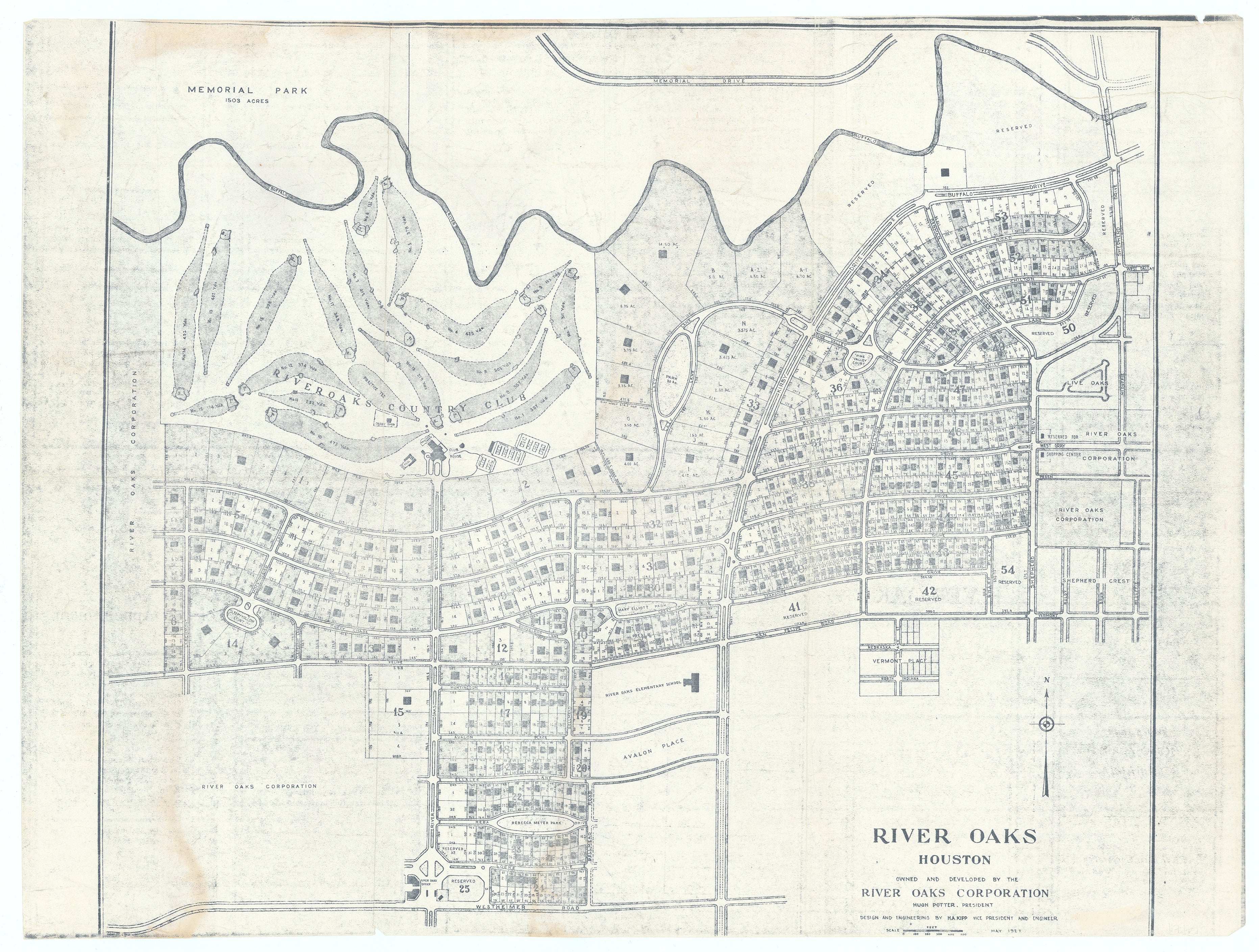
River Oaks, Houston: H.A. Kipp, 1927[c.1935]
- Title: RIVER OAKS HOUSTON | OWNED AND DEVELOPED BY THE RIVER OAKS CORPORATION | HUGH POTTER, PRESIDENT
- Author: H.A. Kipp
- Date: 1927 [c.1935]
- Condition: Very Good - Minor age related toning and minimal paper loss at edges. Some creases at issued folds.
- Inches: 23 7/8 x 18 [Paper]
- Centimeters: 60.64 x 45.72 [Paper]
- Product ID: 308585
"Where Prestige Takes Root: River Oaks—The Gold Standard of Texan Living"
Exceedingly rare original photomechanical rendering of the River Oaks residential layout, commissioned by the River Oaks Corporation and attributed to H. A. Kipp, who served as both vice president and chief engineer.
In 1923, Potter secured an option to purchase land surrounding the River Oaks Country Club, leading to the acquisition of 1,100 acres and the formation of River Oaks Corporation. As president of the corporation, Potter was instrumental in implementing innovative urban planning, working alongside prominent landscape architects Hare & Hare and consultant J.C. Nichols to create a master plan focused on environmental preservation, infrastructure improvements, and strict residential deed restrictions ensuring exclusivity and aesthetic harmony. Potter acted as the public face of River Oaks; he tirelessly marketed the development as "not just a neighborhood but a lifestyle," using magazines, civic forums, and newspapers to cement its reputation for elite status and suburban beauty.
Kipp’s subdivision plat was filed in 1924, and early lots were sold to club members. His engineering vision influenced subsequent master plans for the entire development, helping River Oaks become a celebrated national model for suburban design, praised for its integration of natural beauty, social cohesion, and infrastructure excellence. Kipp’s planning principles are still evident in River Oaks today, distinguished by its curving avenues, lush landscapes, and architecturally diverse homes.
River Oaks in the 1930s
River Oaks, Texas in the 1930s was a showcase of master-planned suburban development, renowned for its winding, tree-lined streets, elegant gardens, and exclusivity. By the end of the decade, over $3 million had been invested, transforming what had been rural land into Houston’s most prestigious residential district, characterized by stately homes, strict deed restrictions, underground utilities, and carefully landscaped public spaces. The community pioneered architectural standards and became a model for city planning, drawing local elite and shaping patterns for future Houston neighborhoods.
Background on Creator(s)
Hugh Potter was a pivotal figure in the development and shaping of River Oaks, Houston’s premier planned residential community. Born in Gainesville, Texas, Potter attended the University of Texas—where he served as student body president and helped establish the Friars Club—before earning his law degree at Harvard University. After practicing law (including being admitted to the Supreme Court and serving as special judge), Potter joined longtime friends Will and Michael Hogg in a visionary real estate venture that would transform the city.
H.A. Kipp (Herbert A. Kipp) was a significant engineer and planner in the early development of River Oaks, Houston’s most prominent residential neighborhood. In 1923–24, as the Country Club Estates Company prepared to subdivide land south of Buffalo Bayou, Kipp was retained as the lead engineer to design the initial residential sections, specifically on the 181–178-acre tract adjacent to the new River Oaks Country Club.
Role and Influence
Kipp’s work was foundational in establishing the signature features of River Oaks. He devised a plan employing wide, curvilinear streets for aesthetic appeal and practicality, eschewing the traditional street grid in favor of a park-like suburban layout representing cutting-edge planning of the era. Roads and avenues were often named after notable country clubs, and lot sizes varied from one-quarter acre to four acres, accommodating a range of affluent buyers and reinforcing River Oaks’ reputation for exclusivity. His plan also set aside space for landscaping and helped integrate recreational features along the streets, supporting River Oaks' identity as a prestigious, planned community.
- Title: RIVER OAKS HOUSTON | OWNED AND DEVELOPED BY THE RIVER OAKS CORPORATION | HUGH POTTER, PRESIDENT
- Author: H.A. Kipp
- Date: 1927 [c.1935]
- Condition: Very Good - Minor age related toning and minimal paper loss at edges. Some creases at issued folds.
- Inches: 23 7/8 x 18 [Paper]
- Centimeters: 60.64 x 45.72 [Paper]
- Product ID: 308585
"Where Prestige Takes Root: River Oaks—The Gold Standard of Texan Living"
Exceedingly rare original photomechanical rendering of the River Oaks residential layout, commissioned by the River Oaks Corporation and attributed to H. A. Kipp, who served as both vice president and chief engineer.
In 1923, Potter secured an option to purchase land surrounding the River Oaks Country Club, leading to the acquisition of 1,100 acres and the formation of River Oaks Corporation. As president of the corporation, Potter was instrumental in implementing innovative urban planning, working alongside prominent landscape architects Hare & Hare and consultant J.C. Nichols to create a master plan focused on environmental preservation, infrastructure improvements, and strict residential deed restrictions ensuring exclusivity and aesthetic harmony. Potter acted as the public face of River Oaks; he tirelessly marketed the development as "not just a neighborhood but a lifestyle," using magazines, civic forums, and newspapers to cement its reputation for elite status and suburban beauty.
Kipp’s subdivision plat was filed in 1924, and early lots were sold to club members. His engineering vision influenced subsequent master plans for the entire development, helping River Oaks become a celebrated national model for suburban design, praised for its integration of natural beauty, social cohesion, and infrastructure excellence. Kipp’s planning principles are still evident in River Oaks today, distinguished by its curving avenues, lush landscapes, and architecturally diverse homes.
River Oaks in the 1930s
River Oaks, Texas in the 1930s was a showcase of master-planned suburban development, renowned for its winding, tree-lined streets, elegant gardens, and exclusivity. By the end of the decade, over $3 million had been invested, transforming what had been rural land into Houston’s most prestigious residential district, characterized by stately homes, strict deed restrictions, underground utilities, and carefully landscaped public spaces. The community pioneered architectural standards and became a model for city planning, drawing local elite and shaping patterns for future Houston neighborhoods.
Background on Creator(s)
Hugh Potter was a pivotal figure in the development and shaping of River Oaks, Houston’s premier planned residential community. Born in Gainesville, Texas, Potter attended the University of Texas—where he served as student body president and helped establish the Friars Club—before earning his law degree at Harvard University. After practicing law (including being admitted to the Supreme Court and serving as special judge), Potter joined longtime friends Will and Michael Hogg in a visionary real estate venture that would transform the city.
H.A. Kipp (Herbert A. Kipp) was a significant engineer and planner in the early development of River Oaks, Houston’s most prominent residential neighborhood. In 1923–24, as the Country Club Estates Company prepared to subdivide land south of Buffalo Bayou, Kipp was retained as the lead engineer to design the initial residential sections, specifically on the 181–178-acre tract adjacent to the new River Oaks Country Club.
Role and Influence
Kipp’s work was foundational in establishing the signature features of River Oaks. He devised a plan employing wide, curvilinear streets for aesthetic appeal and practicality, eschewing the traditional street grid in favor of a park-like suburban layout representing cutting-edge planning of the era. Roads and avenues were often named after notable country clubs, and lot sizes varied from one-quarter acre to four acres, accommodating a range of affluent buyers and reinforcing River Oaks’ reputation for exclusivity. His plan also set aside space for landscaping and helped integrate recreational features along the streets, supporting River Oaks' identity as a prestigious, planned community.
Description
- Title: RIVER OAKS HOUSTON | OWNED AND DEVELOPED BY THE RIVER OAKS CORPORATION | HUGH POTTER, PRESIDENT
- Author: H.A. Kipp
- Date: 1927 [c.1935]
- Condition: Very Good - Minor age related toning and minimal paper loss at edges. Some creases at issued folds.
- Inches: 23 7/8 x 18 [Paper]
- Centimeters: 60.64 x 45.72 [Paper]
- Product ID: 308585
"Where Prestige Takes Root: River Oaks—The Gold Standard of Texan Living"
Exceedingly rare original photomechanical rendering of the River Oaks residential layout, commissioned by the River Oaks Corporation and attributed to H. A. Kipp, who served as both vice president and chief engineer.
In 1923, Potter secured an option to purchase land surrounding the River Oaks Country Club, leading to the acquisition of 1,100 acres and the formation of River Oaks Corporation. As president of the corporation, Potter was instrumental in implementing innovative urban planning, working alongside prominent landscape architects Hare & Hare and consultant J.C. Nichols to create a master plan focused on environmental preservation, infrastructure improvements, and strict residential deed restrictions ensuring exclusivity and aesthetic harmony. Potter acted as the public face of River Oaks; he tirelessly marketed the development as "not just a neighborhood but a lifestyle," using magazines, civic forums, and newspapers to cement its reputation for elite status and suburban beauty.
Kipp’s subdivision plat was filed in 1924, and early lots were sold to club members. His engineering vision influenced subsequent master plans for the entire development, helping River Oaks become a celebrated national model for suburban design, praised for its integration of natural beauty, social cohesion, and infrastructure excellence. Kipp’s planning principles are still evident in River Oaks today, distinguished by its curving avenues, lush landscapes, and architecturally diverse homes.
River Oaks in the 1930s
River Oaks, Texas in the 1930s was a showcase of master-planned suburban development, renowned for its winding, tree-lined streets, elegant gardens, and exclusivity. By the end of the decade, over $3 million had been invested, transforming what had been rural land into Houston’s most prestigious residential district, characterized by stately homes, strict deed restrictions, underground utilities, and carefully landscaped public spaces. The community pioneered architectural standards and became a model for city planning, drawing local elite and shaping patterns for future Houston neighborhoods.
Background on Creator(s)
Hugh Potter was a pivotal figure in the development and shaping of River Oaks, Houston’s premier planned residential community. Born in Gainesville, Texas, Potter attended the University of Texas—where he served as student body president and helped establish the Friars Club—before earning his law degree at Harvard University. After practicing law (including being admitted to the Supreme Court and serving as special judge), Potter joined longtime friends Will and Michael Hogg in a visionary real estate venture that would transform the city.
H.A. Kipp (Herbert A. Kipp) was a significant engineer and planner in the early development of River Oaks, Houston’s most prominent residential neighborhood. In 1923–24, as the Country Club Estates Company prepared to subdivide land south of Buffalo Bayou, Kipp was retained as the lead engineer to design the initial residential sections, specifically on the 181–178-acre tract adjacent to the new River Oaks Country Club.
Role and Influence
Kipp’s work was foundational in establishing the signature features of River Oaks. He devised a plan employing wide, curvilinear streets for aesthetic appeal and practicality, eschewing the traditional street grid in favor of a park-like suburban layout representing cutting-edge planning of the era. Roads and avenues were often named after notable country clubs, and lot sizes varied from one-quarter acre to four acres, accommodating a range of affluent buyers and reinforcing River Oaks’ reputation for exclusivity. His plan also set aside space for landscaping and helped integrate recreational features along the streets, supporting River Oaks' identity as a prestigious, planned community.