The Texas Cattle Trade: Harper's Weekly, 1874
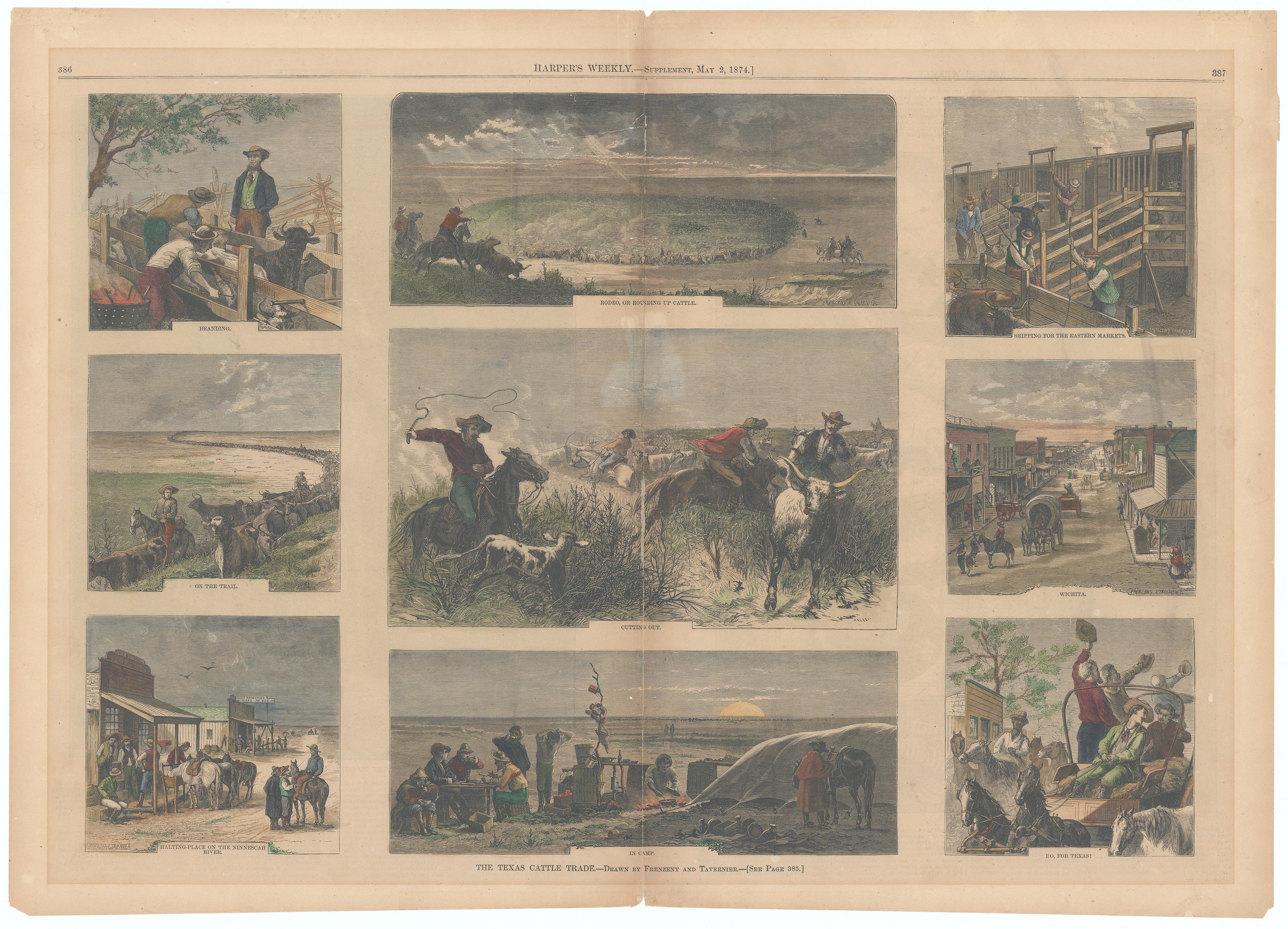
- Title: THE TEXAS CATTLE TRADE - Drawn By Frenzeny and Tavernier
- Author: Harper's Weekly
- Date: May 2, 1874
- Condition: Uniform age toning, tears expertly repaired throughout. Mat burn around image.
- Inches: 19 5/8 x 13 3/4 [Image]
- Centimeters: 49.84 x 34.92 [Image]
- Product ID: 308534
This richly illustrated page from the May 2, 1874 edition of Harper’s Weekly depicts various scenes from the Texas cattle trade, capturing the drama and daily realities of the cattle drives that defined the American West. The engravings portray cowboys herding cattle across vast prairies, branding livestock, and racing after strays in action-packed pursuits. Additional vignettes show bustling towns along the cattle trails, livestock being loaded for shipment at market, campfire gatherings at sunset, and moments of exploration and negotiation. Together, these vivid images present a lively, authentic portrait of frontier life and the central role of the cattle industry in shaping Texas and the broader region during the late nineteenth century.
Background on Creator
Harper's Weekly, formally known as Harper's Weekly: A Journal of Civilization, was an influential American political magazine published from 1857 until 1916 by Harper & Brothers. It gained prominence for its extensive coverage of the American Civil War, providing readers with both news and striking illustrations that depicted the realities of war. The magazine featured notable contributions from prominent illustrators and writers, including political cartoonist Thomas Nast, whose work helped shape public opinion during a tumultuous period in American history.
The publication was characterized by a blend of serious journalism, fiction, essays, and humor, making it a staple for readers interested in current events and cultural commentary. Its editorial stance evolved over time, initially supporting the Union cause during the Civil War and later addressing various social and political issues of the day. With a peak circulation of over 200,000 copies, Harper's Weekly played a crucial role in informing and influencing public discourse in the United States until its final issue in 1916.
- Title: THE TEXAS CATTLE TRADE - Drawn By Frenzeny and Tavernier
- Author: Harper's Weekly
- Date: May 2, 1874
- Condition: Uniform age toning, tears expertly repaired throughout. Mat burn around image.
- Inches: 19 5/8 x 13 3/4 [Image]
- Centimeters: 49.84 x 34.92 [Image]
- Product ID: 308534
This richly illustrated page from the May 2, 1874 edition of Harper’s Weekly depicts various scenes from the Texas cattle trade, capturing the drama and daily realities of the cattle drives that defined the American West. The engravings portray cowboys herding cattle across vast prairies, branding livestock, and racing after strays in action-packed pursuits. Additional vignettes show bustling towns along the cattle trails, livestock being loaded for shipment at market, campfire gatherings at sunset, and moments of exploration and negotiation. Together, these vivid images present a lively, authentic portrait of frontier life and the central role of the cattle industry in shaping Texas and the broader region during the late nineteenth century.
Background on Creator
Harper's Weekly, formally known as Harper's Weekly: A Journal of Civilization, was an influential American political magazine published from 1857 until 1916 by Harper & Brothers. It gained prominence for its extensive coverage of the American Civil War, providing readers with both news and striking illustrations that depicted the realities of war. The magazine featured notable contributions from prominent illustrators and writers, including political cartoonist Thomas Nast, whose work helped shape public opinion during a tumultuous period in American history.
The publication was characterized by a blend of serious journalism, fiction, essays, and humor, making it a staple for readers interested in current events and cultural commentary. Its editorial stance evolved over time, initially supporting the Union cause during the Civil War and later addressing various social and political issues of the day. With a peak circulation of over 200,000 copies, Harper's Weekly played a crucial role in informing and influencing public discourse in the United States until its final issue in 1916.
Original: $265.00
-65%$265.00
$92.75Description
- Title: THE TEXAS CATTLE TRADE - Drawn By Frenzeny and Tavernier
- Author: Harper's Weekly
- Date: May 2, 1874
- Condition: Uniform age toning, tears expertly repaired throughout. Mat burn around image.
- Inches: 19 5/8 x 13 3/4 [Image]
- Centimeters: 49.84 x 34.92 [Image]
- Product ID: 308534
This richly illustrated page from the May 2, 1874 edition of Harper’s Weekly depicts various scenes from the Texas cattle trade, capturing the drama and daily realities of the cattle drives that defined the American West. The engravings portray cowboys herding cattle across vast prairies, branding livestock, and racing after strays in action-packed pursuits. Additional vignettes show bustling towns along the cattle trails, livestock being loaded for shipment at market, campfire gatherings at sunset, and moments of exploration and negotiation. Together, these vivid images present a lively, authentic portrait of frontier life and the central role of the cattle industry in shaping Texas and the broader region during the late nineteenth century.
Background on Creator
Harper's Weekly, formally known as Harper's Weekly: A Journal of Civilization, was an influential American political magazine published from 1857 until 1916 by Harper & Brothers. It gained prominence for its extensive coverage of the American Civil War, providing readers with both news and striking illustrations that depicted the realities of war. The magazine featured notable contributions from prominent illustrators and writers, including political cartoonist Thomas Nast, whose work helped shape public opinion during a tumultuous period in American history.
The publication was characterized by a blend of serious journalism, fiction, essays, and humor, making it a staple for readers interested in current events and cultural commentary. Its editorial stance evolved over time, initially supporting the Union cause during the Civil War and later addressing various social and political issues of the day. With a peak circulation of over 200,000 copies, Harper's Weekly played a crucial role in informing and influencing public discourse in the United States until its final issue in 1916.